
Deutsch: Kosten für das Bürgerrecht sinken
Türkisch: Vatandaşlık başvuru ücretleri düşüyor!
From July 1, financial barriers to applying for naturalisation in Basel will be significantly reduced. Evrim Yılmaz spoke with Grand Council member Mahir Kabakçı, who played an active role in driving this change.
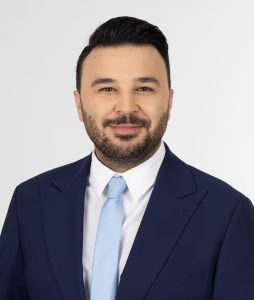
This discussion actually began in Basel back in 2022. I spoke with Mahir Kabakçı, who played a key role in the recent regulation to reduce naturalisation costs, aiming to open the way for greater political participation.
mozaik: Why was such a step taken? Who initiated the process?
Mahir Kabakçı: In recent years, naturalisation fees in Basel-Stadt were heavily debated. The starting point of these discussions was the idea that high costs can pose both a financial and social barrier for many people. This particularly affected young people, individuals born here with a migration background, and those with limited financial means. The goal of the political debate was to make access to political participation fairer.
Within this framework, I submitted a political motion to reduce or abolish naturalisation fees. My aim was to lower financial barriers and strengthen the political participation of well-integrated individuals.
How long did it take for this legal change to be adopted, and when will it come into effect?
The political decision-making process took several years. The motion was submitted in 2022, followed by committee consultations and debates in the Grand Council. This long process shows that changes in democracies take time, as different views and interests must be considered.
With the Grand Council’s decision, the reform is expected to come into force on July 1, 2026. Under the new rules, for people up to 25 years old, cantonal and municipal naturalisation fees will be completely abolished. These individuals will only pay the federal fee of 100 francs (previously, total costs for adults were around 1,750 francs).
Fees have also been reduced for those over 25. After the reform, the total cost will be approximately 900 francs. As can be seen, the cantonal share for this group has also been significantly reduced. People with financial difficulties may additionally be fully exempted from cantonal and municipal fees, meaning that in some cases they will only pay the federal fee.
What change do you expect in naturalisation applications following this reform?
I expect that these measures will encourage more people to apply for naturalisation. Research and political debates show that costs are an important factor influencing whether someone applies. Eliminating fees for young people removes a significant financial barrier. Of course, naturalisation still depends on requirements such as language skills, integration, and social participation. Reducing or abolishing fees is a step toward lowering existing barriers but does not replace other legal requirements.
This process demonstrates that societal change often arises from long-term political work, discussion, and compromise. The goal of this reform is to facilitate access to citizenship for well-integrated individuals and strengthen political participation in the long term.
As someone born and raised here and active in politics, what do you think is the reason for the racist attacks directed at you after the law was passed?
In the context of these political efforts, it is important to interpret societal reactions correctly. There is no simple answer to this question, as racist attacks often stem from a combination of societal factors. I think debates about migration, integration, and citizenship in the public sphere are sometimes highly emotional. When such topics enter politics, they can provoke strong reactions in some individuals.
In a democratic society, these discussions need to be conducted respectfully and objectively. I do not believe that political decisions or engagement alone should be the cause of such attacks. Rather, these incidents show that dialogue and awareness-raising are still necessary in society to reduce prejudice and promote respectful coexistence.
As someone born and raised here and active in politics, I see my role primarily as contributing to dialogue and advocating for social participation, without accepting hatred or exclusion.
I would like to thank Mahir for both answering my questions and taking the lead in this important initiative, helping to remove one of the barriers to naturalisation. I hope that once the law comes into effect, its impact will be felt and pave the way for a more pluralistic Basel — and, in turn, a more inclusive Switzerland.
Evrim Yılmaz
Reasons not to apply
A 2025 study by Bischof, Liechti, Sager, and Guggisberg for the State Secretariat for Migration (SEM) examines why many eligible individuals — including second- and third-generation immigrants — do not apply for Swiss citizenship. According to the survey, decisions are influenced by a combination of practical, emotional, and personal factors.
Most participants see integration and political rights as strong reasons to naturalise. However, 56 % cite financial concerns, and 54 % find the process complex or demanding.
Reasons for not applying vary by personal background: those raised in Switzerland often see naturalisation not as something to «apply» but as a right, and therefore do not apply in response. Younger men sometimes view compulsory military service as a barrier, while older individuals feel they cannot meet the requirements or believe it is too late.